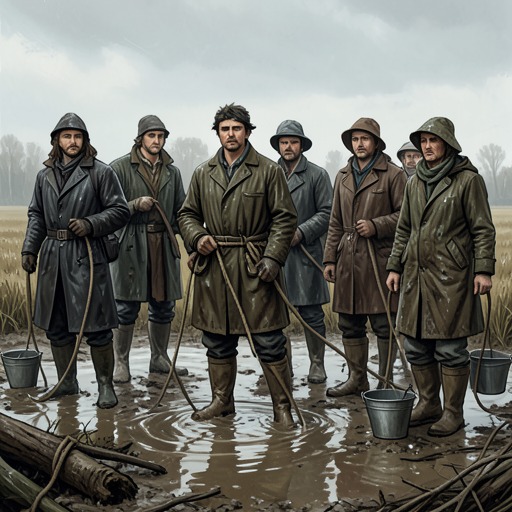
2008 Cedar Rapids flood and volunteer relief effort
Big BrotherThe 2008 Cedar Rapids flood and volunteer relief effort is a turning point in the account of Pandora and Edison’s life together: a catastrophe interrupts the private regimen of weight loss and makes room for strenuous work, collective need, and a more complicated measure of change. The worst flood in Iowa on record draws them into days of sandbagging and emergency protection, where Edison—once imagined as someone who would watch such a disaster on television—becomes a comfort to people who have lost nearly everything.## Background and Stakes The flood comes during the period when Pandora and Edison are living together at Prague Porches and trying to lose weight. Pandora looks back on that month as a welcome distraction from the enclosed intensity of her brother’s body and their plan. The disaster is no mere backdrop: reconstruction remains unfinished, and she recognizes that calling it a disaster means acknowledging losses that outlast the immediate crisis. Yet the work gives her a larger canvas than the daily effort to manage Edison’s eating and her own hunger.
The practical consequences vary with elevation and circumstance. New Holland sits on raised ground, but basements there fill with water. Pandora cannot help Cody and Fletcher move furniture stored in their basement because she is persona non grata with them; their table saw, Fletcher’s most treasured tool of his trade, is too heavy for them to manage and is ruined. At Prague Porches, on the second floor, Pandora and Edison do not have to fear for Edison’s upright piano. With their own belongings secured on upper shelves, Pandora closes Monotonous until further notice so her employees can join the relief effort.
The scale is extraordinary: the flood is described as the worst in Iowa on record, a disaster of a magnitude the state should expect no more than once in five hundred years. That rarity does not make the danger abstract. The Cedar River keeps rising even after the rain stops, while the volunteers’ exertion and the water’s advance make the crisis a sustained, changing emergency rather than a single dramatic moment.## The Relief Effort Pandora discovers that catering is not the most fatiguing work she has done: sandbagging is. She rotates between shoveling, passing bags down the line, and stacking pallets to use different muscles. Volunteers generally reserve the job of holding open sacks while another person shovels for children, and whole families arrive to help. Cody joins the effort on a couple of afternoons, but family tensions shape where she can work: she usually lends a hand nearer New Holland with her father, trying to find out where Pandora and Edison are so Fletcher can work somewhere else.
For five solid days, volunteers work around the clock, piling lines of sandbags along the Cedar River and at downtown business entrances. They relay stacks around the Cedar Rapids Public Library as another group packs books into cartons for transfer to the second story. At Mercy Medical Center, they fortify the ground floor to protect generators in the hospital basement. The work is local and concrete—bags, books, vulnerable equipment—but its scale is communal, drawing thousands of area residents into the same exhausting chain of labor.
Among them are a handful of Katrina survivors who drive up from Louisiana with vats of Cajun chicken and a knowing, been-through-this-before attitude that irritates some people. The volunteers’ good humor is otherwise contagious. KCRG’s call for help eventually brings more people than the effort can use, and the station has to ask would-be helpers to stay away. Pandora sees those turned back as the only people acting grumpy: they have braved the conditions only to be told they are not needed, and in a sense they have been cheated of the chance to help.## Edison’s Place in the Work The relief effort exposes the distance between Edison’s condition when he arrived and his conduct during the flood. Pandora remarks that the brother who came to New Holland nine months earlier would have put his feet up and watched the spectacle on television. Now he throws himself into the community effort. She and Edison joke about his former weight: she recalls that he would have been little use at three hundred eighty-six pounds, and he answers that six months earlier he would have been one of the sandbags. The exchange measures change without making the disaster a simple triumph over his body; the work matters because he is present, useful, and in company.
Edison also offers displaced residents a form of comfort that grows from his own earlier losses. Workers relocated to Prairie High are trying to think about the furniture, electronics, and wardrobes left behind in evacuated neighborhoods. Many have saved only photographs and a change of clothes; some stop in the middle of a sandbag relay, shoulders slumping as they remember a particular lost possession, such as a quilt inherited from a great-grandmother. Many of those whose homes were newly reached by the river have no flood insurance because they did not previously live on a flood plain.
Edison tells them that he once lost nearly everything he owned, keeping only a few clothes that no longer fit and an old computer. He reframes that loss as a kind of cleansing: possessions, he suggests, can weigh a person down and shape the person who owns them, while losing them can make another identity imaginable. As he speaks, he hefts a sandbag along the line, turning the metaphor into a visible action. His reassurance does not restore what the flood has taken, but it lets him meet other people’s grief as someone with relevant experience rather than as a passive object of concern.## Food, Discipline, and a Changed Measure The flood also unsettles the strictness of Pandora and Edison’s diet. For the first two days, Edison weighs smoked turkey for his scant packed lunch. By the third, they have run out of sandwich meat. After a shift, a grateful local business brings in pizza pies. Edison is horrified, as eating pizza would ordinarily violate the rules they have made central to their plan. Pandora tells him that he has expended fifteen hundred calories in sandbagging and orders him to eat. The thin-crust pizza is not even his preferred New York style, but he later calls it the best pizza he has ever had—an assessment tied to the labor and relief that surround the meal, not simply to its forbidden status.
The episode gives their pact a different context. Earlier, hunger and discipline have been private tests, bound up with their bodies and Pandora’s determination not to abandon the effort. During the flood, the work itself consumes energy, and eating becomes compatible with the immediate demands of helping others. Pandora acts not as a guardian of an abstract prohibition but as Edison’s coach in a situation where food supports the labor they have undertaken together.
In retrospect, Pandora treats the flood month as evidence of a change in Edison, while also resisting the idea that transformation can be narrated as a neat, certain result. Her imagined account of his later life, she admits, is partly a story she tells herself; even the weight of three hundred eighty-six pounds was only a guess. But the volunteer effort is presented as something she witnessed: Edison works, encourages strangers by drawing on his own losses, and shares a meal after the day’s exertion. The flood does not resolve the larger uncertainties of his health or their family responsibilities. It does, however, shift the frame from a brother’s body as a private burden to a brother acting among other people in need.## Narrative Significance The Cedar Rapids relief effort turns a period organized around restriction into one organized around contribution. Its scale is public, but its meaning is intimate: Pandora’s memories of Edison’s earlier passivity are set against his sustained work beside thousands of volunteers, while the lost possessions of flood survivors meet his own account of homelessness and dispossession. The comparison does not erase differences between their circumstances; it gives Edison a way to speak to people whose losses are newly raw.
The event also complicates the story’s language of weight. Sandbags are literal loads to be lifted and relayed; Edison’s reflection on possessions makes material weight emotional as well. His past losses become useful to others, and physical exertion replaces the passive spectacle Pandora once imagines him watching. At the same time, the pizza marks a small but consequential reversal: the diet’s rules yield to the needs of a body that has spent the day serving a community. The episode offers no final cure or simple moral. Its significance lies in the change it makes visible—Edison taking part, helping, and being able to give something to people who have lost what they owned.